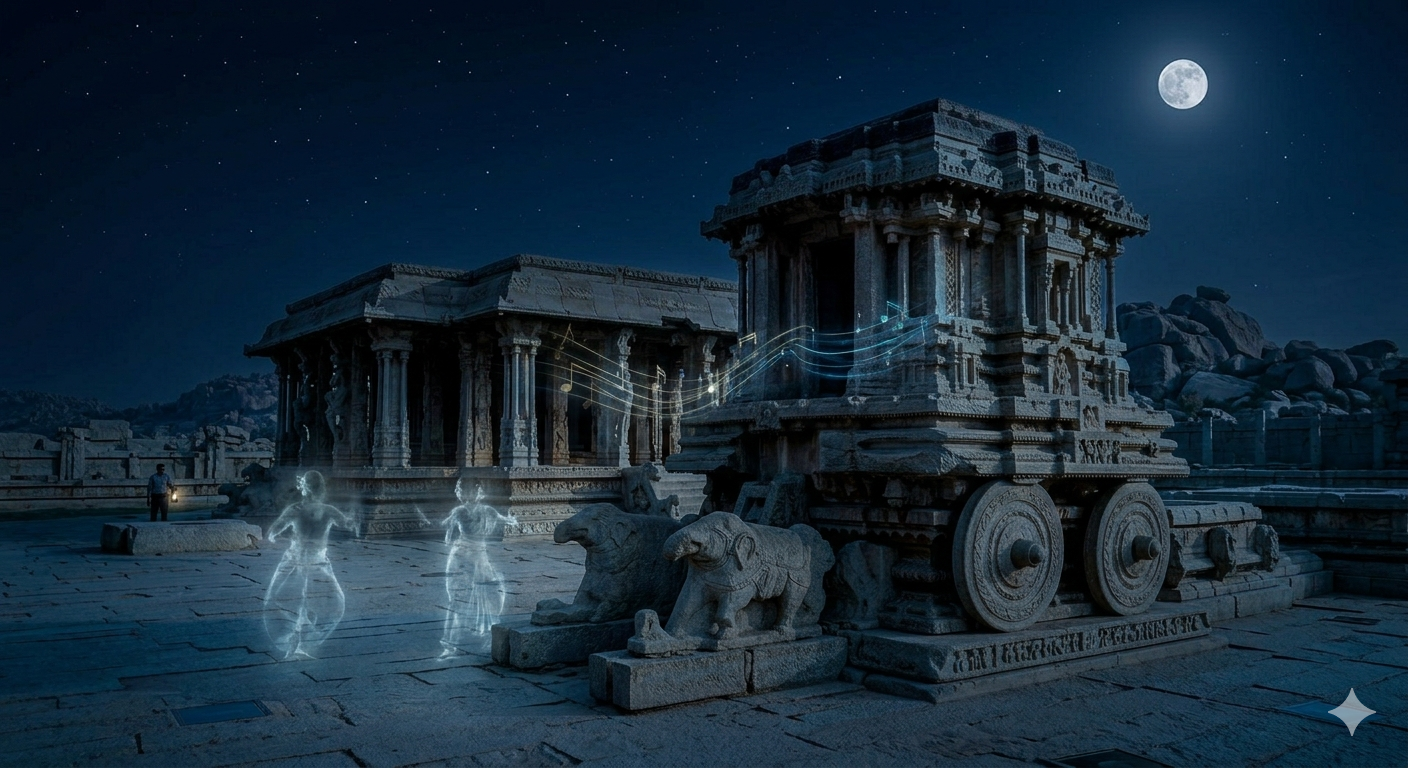
The Most beautiful Historical site Hampi is located is Vijayanagar District of Karnataka in India. The places is famous for the Musical Pillars and Chariots because of which the location attract many tourist through out the world. It is nearly 13 kilometers away from the town Hospet which has a Railway Station too. The Heritage site is located on the bank of River Tungabhadra a major river of South India. The place is associated with the 14th century Vijayanagara Empire and houses a most ancient temple called Vittala Temple which is considered as an architectural marvel. The stone chariot present here is a iconic symbol of Indian heritage. But its Maha Mantapa-the legendary musical pillar has a legend associated with. A story which is real or fake not known but prevailling in this area.
The Vittala Temple constructed during the reign of King Devaraya II and further constructed by the great Krishnadevaraya, is a masterclass in Dravidian craftsmanship. However, the true intrigue for historians and travelers alike is the acoustic property of the slender granite columns. Often referred to as the SaReGaMa pillars, these stones emit distinct musical notes when tapped gently.
The Historical Fact: During the British era, two pillars were reportedly cut open to check if they contained metal or hollow tubes. To their surprise, the columns were found to be solid granite, leaving the colonial engineers baffled by the ancient acoustic science.
Where History Meets Mystery
The Place attracts many historians to conduct historical research. but when the complex of Hampi become alone, It is during these hours that the line between documented history and local legend begins to blur. Local guides and guards, who have spent decades patrolling the ruins, often speak of a “residual energy.” There are accounts—unverified yet consistent—of the faint sound of anklets (ghungroos) and the rhythmic hum of a veena emanating from the sanctum when the site is empty.
The 2014 Incident: A Skeptic’s Encounter
Our huntedreal team is always eager to know the past legends. We hard about a legends associated with this place. The incident is of 2014 when a group of Research students comes here for their studies. They comes from Bengaluru and reportedly experienced something unussual. While staying at a nearby guest house, they claimed to have witnessed silhouettes moving near the stone chariot under the moonlight. When the security lanterns were turned toward the spot, the area was desolate. While skeptics attribute such sightings to the “Pareidolia” effect—where the human brain perceives familiar patterns (like human figures) in random shadows—the locals have a different perspective. They believe these are the “Shilpis” (architects), who remain eternally bound to their magnum opus.

A Legal and Cultural Perspective
It is very hard to distinguished between superstition and heritage. But again a question arises in mind that why the Archaeological Survey of India maintain a strict No Entry After Sunset Policy in Hampi. Perhaphs something is there otherwise an established and responsible organisation of India may not do that. However this can be seen from a positive angle that this is a measures to prevent vandalism in Vittala Temple or to kept the historical property safe or for the safety of the tourist.
However, this administrative boundary has inadvertently fueled the temple’s paranormal reputation. By documenting these stories, we are not validating the supernatural, but rather preserving the “Intangible Cultural Heritage” of India—the stories that live in the gaps of history books.
The Final Word
The Vittala Temple remains a testament to India’s glorious past. Whether the sounds heard at night are atmospheric echoes or something more profound, they serve to keep the history of Hampi alive in the public imagination. To visit Hampi is to walk through a gallery of stone; to listen to its legends is to feel the heartbeat of an empire.